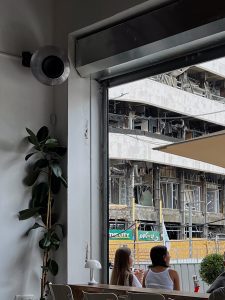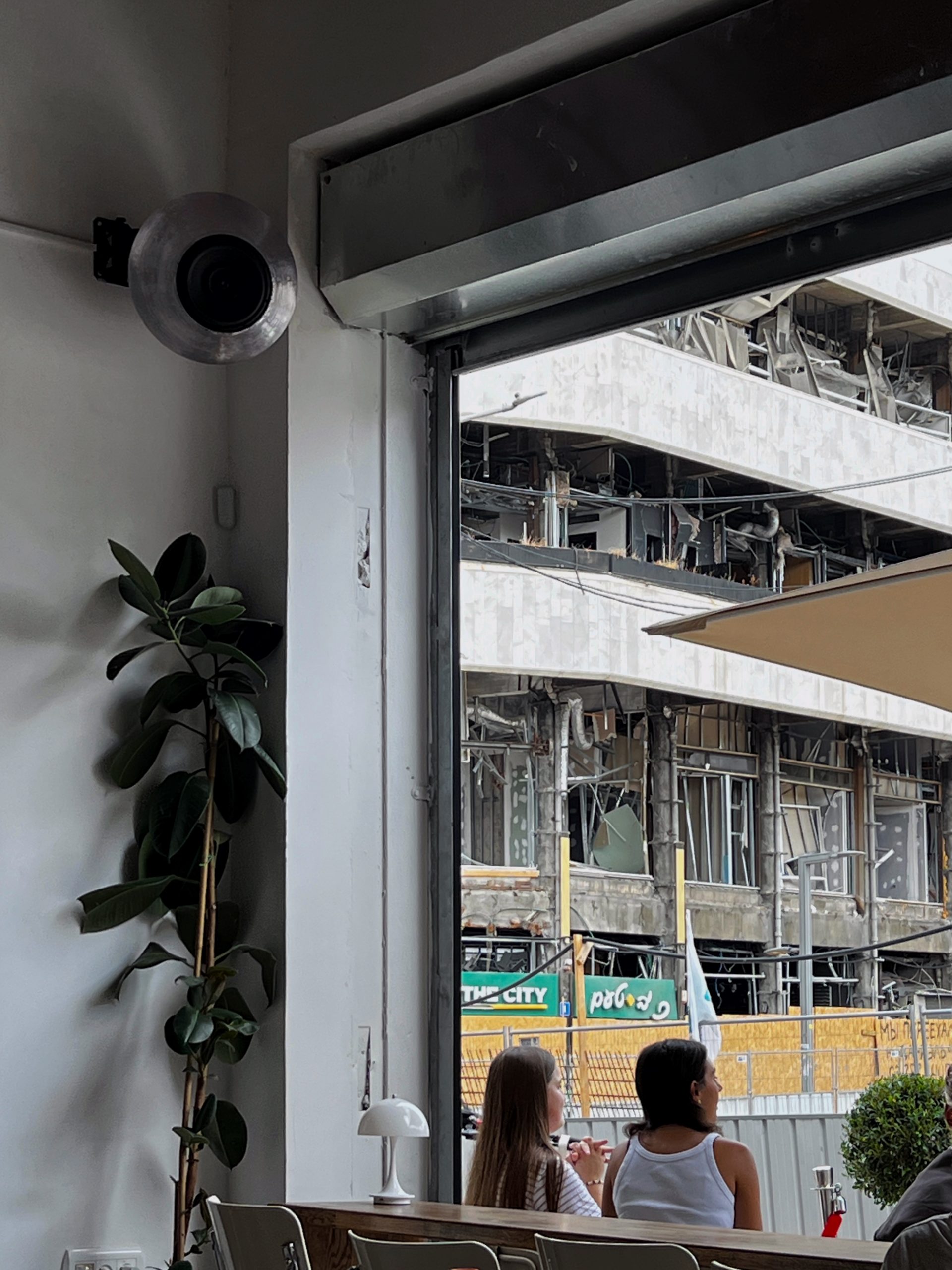
Upon first glance when walking into Norish, one might think that it’s simply a casual neighborhood café- but life is all about context. As you look around the surrounding streets, it slowly begins to sink in that something has happened here, that there is a powerful story that lies behind everyone’s favorite coffee shop.
On the night of Friday the 13th of June, 2025, the Iranian regime launched multiple barrages of ballistic missiles into major civilian populations within Israel. Norish, a café open only for three and a half months, was nearly decimated by one of the detonations. A shock to the area, all that remained were the shattered buildings, their windows blown out, laundry still hanging on clotheslines, the echo of lives left permanently on pause.
Now in November of the same year, Norish has risen from the ashes, built anew, more alive than ever. I had the privilege to sit down with the café’s founder, Lidor, to understand the many stories which have come to compose the creation, destruction, and rebirth of Norish.
Despite the warlike damage surrounding us, Lidor has that classic Israeli calmness, sipping his coffee as we sit in the sun beside his dog, Billie. Even with the heaviness of the topic, he smiles, his words carrying the resilience of his story in each breath.
Sammie: I like to focus on the purpose, the meaning behind a business. What would you say is your “why” behind the founding of Norish?
Lidor: After October 7th [2023], I realized I don’t want to work for someone else. I want to work for myself, to do the things I love to do. Before, we had a community where we were hosting events and just doing it for fun. I wanted to bring a new cultural place to Tel Aviv- after the 7th, I felt like people really needed it.
Sammie: I’m sure experiencing the trauma of October 7th put everything into perspective. There’s a lot in a name, what’s the meaning behind “Norish?”
Lidor: “Norish” is a combination of three names- three good friends that we lost on October 7th. Noam, Omri, and Shai. They loved music, culture, dance; they were a part of our community. It felt natural to name it after them.
Sammie: That’s a beautiful way to honor them, it adds a whole other layer to your story. I notice a lot of art and music references throughout the space, where does that come from?
Lidor: The art is from a friend who’s a street and graffiti artist, a really talented guy. I love it- I love being a friend of his and saying “Everyone needs to see this!” I said to him, what’s better than drinking a coffee and seeing art at the same time, and with music, which is even more art? That’s the connection we created in this place. I’m more of a numbers guy and he understands art, so I thought, okay, we can’t do it alone- so let’s do it together.
Sammie: That’s beautiful. I like to believe that success is also bringing up those around you. Now on to a few questions about the IRGC attack. Where were you when you found out about the destruction from the missiles?
Lidor: I live just 500 meters from here. The minute that the missile hit, we could feel it in the shelter. At the same time, I received a phone call from the alarm system in the café- I turned to my fiancée and said “I think my business is ruined.” When I could leave the shelter, I ran here- one of my employees had lost his entire home, and the whole area was like a warzone.
Sammie: To see the destruction, even now months later, is surreal. What was the rebuilding process like?
Lidor: The damage was expensive and we had only been open a few months. But in Israel, people help each other. The people who work here said “don’t worry about anything, we will help rebuild now and then later on you can pay us.”
Sammie: I have seen that Israelis have an understanding of life that’s so different from most of the rest of the world because every single person here has faced death. Especially in times like these, the way people come together- you just don’t seem to see that anywhere else. How has the Tel Aviv community helped you in this time?
Lidor: The day that the missile hit, we got thousands of messages from people not only in Israel, but around the world. They told us “We love you, we are waiting for you, we will help you rebuild and reopen.” I know the strength of the people of Israel, that people help each other. When you come here, you see it. We were able to rebuild even though the area still looks like a warzone. This is Israel, there’s power in this small nation- we are stronger together. We got messages from other businesses, the best coffee shops in Israel. They said “Whatever you need, whatever you do, we are here for you.”
Sammie: Having that community is everything. What lessons can you say you took from this whole experience?
Lidor: To rebuild was the hardest thing I’ve done in my life. To be uncertain- the power is not in your hands. But we had to rebuild. I had quit my tech job for this, we put everything into it. We had no other option. Imagine you put all your money, all your time, all your efforts into something- and it’s destroyed. And there’s no one we can really point the finger at; we just had to rebuild. It’s not a normal situation, but it’s a really Israeli situation. And when it got hard, we remembered why we opened in the first place.
Sammie: It’s definitely a different struggle than most entrepreneurs face. What do you think is next for you and Norish?
Lidor: First, I need a vacation [laughs]. We plan to bring back the culture, the events, the live music, and a lot of collaborations. Back to business, to do what we came to do and to show the world what is Norish.
Sammie: In presenting your business to the world, how do you, as an Israeli, deal with being misunderstood by the international community?
Lidor: Sometimes someone comes and speaks low words to you. And I look at him and feel sorry for him. Because he has not tried to see the truth. If you come here [to Israel], and you actually meet the people, you’ll see it. I know what it really means to be an Israeli, to be part of all of this.
Sammie: My final question- if you had one message for the people of Israel right now, what would it be?
Lidor: That we have the strength, we have the power to do whatever we need to do. People in Israel know it, but sometimes we forget. No matter the situation, no matter how other people in the world may think of us, it’s temporary. There is hope that it will be brighter in the future. I think people will always try to find something to say about us, about the Jews. And it’s been like this for many years. But I think we have learned how to live with it, and how to not give it so much importance. It’s time for the people of Israel to heal themselves. And they will start tomorrow [with the return of the hostages] to really understand what has happened over these past two years.
My utmost gratitude to Lidor and the team at Norish for this conversation. You can support them by visiting the café at Allenby Street 36 in Tel Aviv and by following their story on Instagram at @norish.cafe